A few weeks back I made another visit to the Lorance Creek Natural Area with the hopes of catching some good fall color on the cypress and tupelo trees there. But my timing was off, and almost all of the leaves had already fallen off the trees. There were a few good patches of color still clinging on, mostly on some of the oak trees.
The sky provided another nice bit of color, it was close to sunset and the creek was reflecting some colorful clouds floating above.
The fallen leaves ended up in Lorance Creek, flowing along past the tall trees. At one point, the leaves got caught in the current and swirled around. This was taken when it was nearly dark, with a long exposure capturing the motion of the leaves as they slowly floated around in circles.
Since I was in the area, I decided to make a quick visit to Alum Cove. The trail is popular, and the star attraction is the massive natural bridge. There was a good little crowd of people mingling around the bridge, and while waiting for people to disperse I spotted this leaf laying on top of a log that was covered with thick moss.
The natural bridge is 130 feet long and 20 feet wide, big enough that you could actually drive a car across it (if you could manage to get it down the hill, of course). Apparently this was once a large cave, but the center section of the roof collapsed and left behind the large arch.
And the view from the other side, where a little waterfall spilled over the edge and then flowed under the bridge.
There are lots of historical places within the boundaries of the Buffalo National River, and one of the largest and well-preserved is the old Parker-Hickman Homestead. The homestead is situated at the foot of a ridge, not too far from the waters of the Buffalo River. The oldest building here dates back to the late 1840s, and is believed to be the oldest building in the park. It's hard to imagine what it must have been like when the first settlers cleared the land and built the log cabin by hand.
Amazingly, the home was occupied until 1978. In 1982 the National Park Service purchased the property and stabilized and preserved the home and the other buildings in the homestead. While the home is empty now, the door is unlocked and you are invited to go inside to take a look (just please don't leave graffiti or mess anything up!). Although the home hasn't been occupied in over 40 years, you can still see hints of the home's past. In one room, there are layers of newspaper stuck to the wall. In the olden times, people used newspaper as a sort of insulation.
At the back of the house is an addition, which was completed in the early 1900s. The house has seen a lot of history, even during the Civil War. Near the end of the war after US troops liberated Little Rock and the fledgling Confederate government had to flee, most of the mountainous areas of the state was left uncontrolled by either army. In the power vacuum that followed, guerrilla fighters roamed the countryside. A skirmish among dueling guerrilla fighters occurred near the Parker-Hickman Homestead, and the home was used a field hospital.
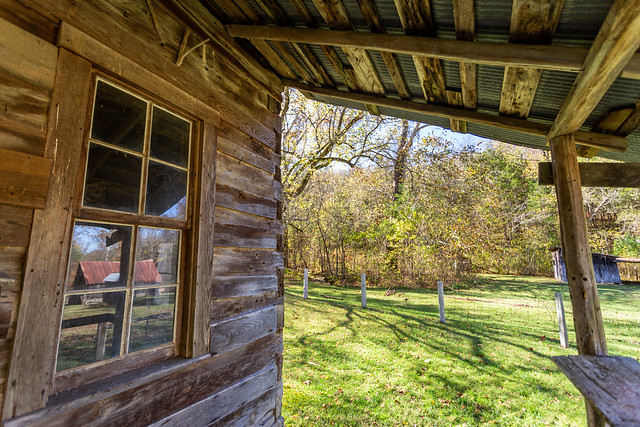
The house also has a nice front porch, from which you can see the other buildings in the farmstead. Along with the house, there are several barns, sheds, a granary, a smokehouse and even a little outhouse (which dates back to the 1920s, but I didn't investigate to see how it was). This is the view of the porch, with one of the barns reflected in the window.
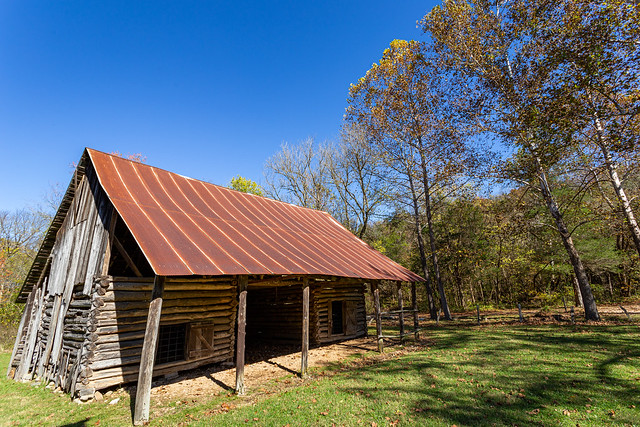
The largest barn in the homestead dates back to 1912.
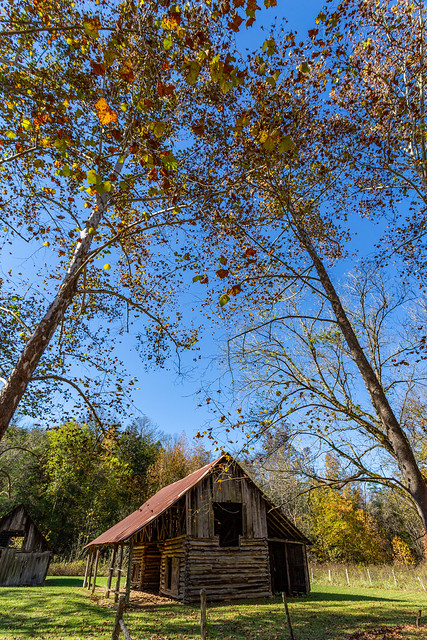
And one final shot of the barn, framed under these towering trees showing off a bit of fall color.
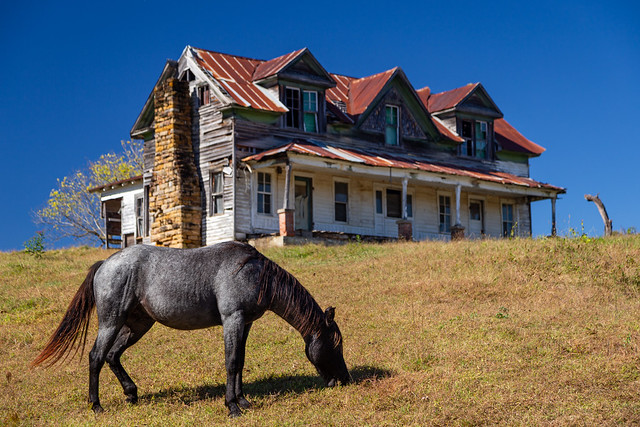
We live in a modern world where we can find out all sorts of information in a heartbeat. Our cellphones are tiny super-computers that can access all the known knowledge of the world at any time, letting us research any random thing when we need to (although it's mostly used for people to argue politics on Facebook or look at cat pictures). So it is a bit frustrating when the internet lets you down, and there isn't much information out there for something. Like, for instance, this amazing old house near the small community of Mt. Judea. I did my best, but I couldn't find anything about it or it's history. The once-grand two story home sits empty and abandoned, seemingly for decades. No one lives there, but there are a few horses around to keep it company.
I'm not an expert on old buildings, but I would guess that it probably dates to the late 1800s. The old house is actually close to the notorious hog farm that the state finally closed because it was polluting the Buffalo National River.
The next morning we headed out to take a few pictures, and again ended up in the area around Big Piney Creek and Haw Creek. Although it was a sunny day, the valley was still shrouded under a thick coat of fog. We hurried to get some pictures, stopping first at the old Fort Douglas schoolhouse (which was built in 1946).
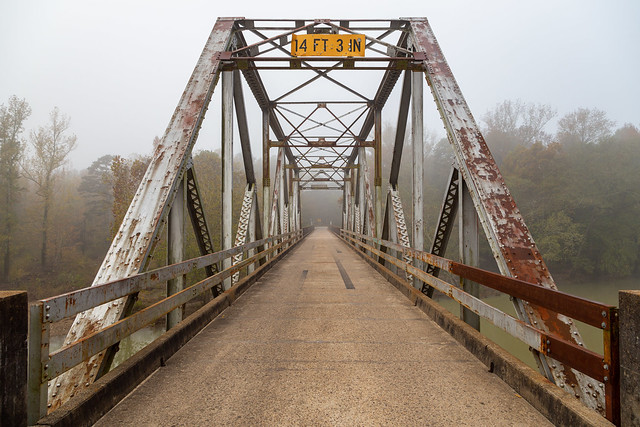
And then we drove across the historic Hwy. 123 bridge over Big Piney Creek. The narrow one-lane bridge was built in 1931.
Luckily there wasn't much traffic out that morning, so we were able to stop on the bridge for a few quick pictures.
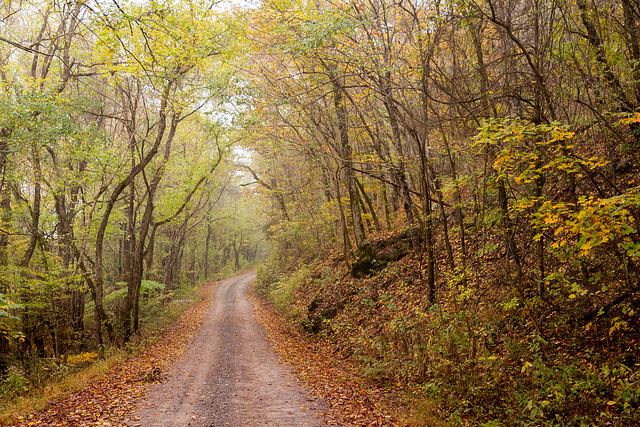
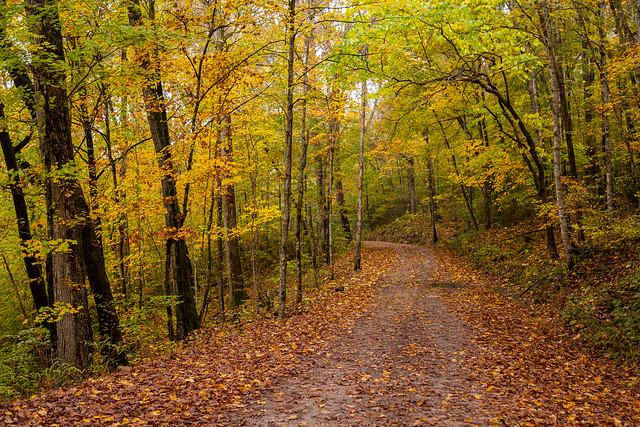
Next to the creek is a dirt road that heads off into the woods alongside the creek. It's a fun little road to drive down, especially on a foggy morning with vibrant fall colors.
But it isn't the easiest road to drive down, since the road runs right into Big Piney Creek. In order to go further, you have to ford the creek to head on (which is funny to me, since that sounds like something you'd expect wagon trains on the Oregon Trail to do). But luckily we were in Matt's truck. If we were in my car, it would have been immediately submerged and then floated off towards the Arkansas River.
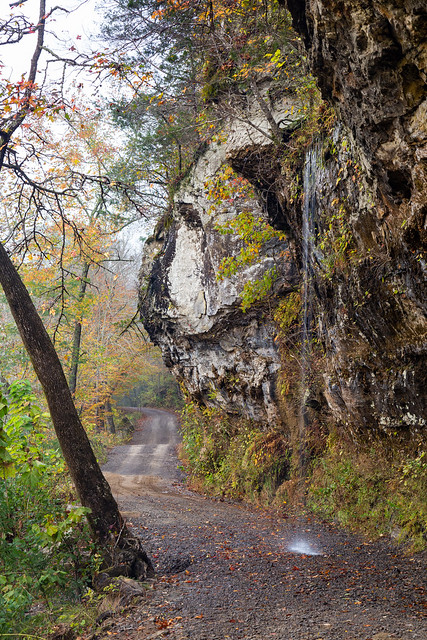
After crossing the Big Piney, the road runs alongside the creek and eventually passes beneath Car Wash Falls. This waterfall is aptly named since you can actually drive right through it, giving your car a nice wash in the process. The falls are 21 feet-tall, and empty right onto the road (just be sure your sunroof is closed before you drive by).
And the view from the car as you pass under Car Wash Falls:
We drove further down the road, making several stops to get pictures of the trees that were showing off their fall colors.
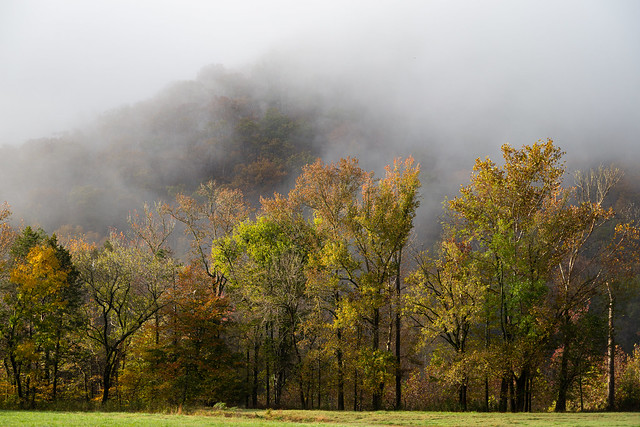
The sun was starting to finally break through the thick fog, and we made a stop along the valley to get a few shots. The retreating fog clung onto the distant hillsides.
We started headed back, but one made one last stop here for a few quick pictures as the last bits of fog drifted above the hills by this old barn.