Showing posts with label Parker-Hickman Homestead. Show all posts

Monday, November 3, 2025

Buffalo National River - Parker-Hickman Farmstead

The next morning I woke up before sunrise again and headed back to the Buffalo River. This time it was to visit the old Parker-Hickman Farmstead at Erbie. It was still raining as I drove north from Jasper, but the rain slacked by the time I made it to the old homestead.

Untitled

The cabin was built by the Parker family in the 1840s, and is the oldest building within the boundaries of the Buffalo National River. It was built just a few years after Arkansas became a state, and the old place has seen a lot of history. During the Civil War, there was a small skirmish nearby involving guerrilla fighters and the old Parker house was used as a field hospital.

Untitled

The cabin and the property were then purchased by the Hickman family, who lived there until 1978. In 1982, the National Park Service acquired the cabin and the surrounding farm. You can take a peek inside the cabin, which is in remarkably good shape considering how old the structure is. In one room, you can see the layers of wallpaper and newspaper on the walls that was used as insulation back in the olden days.

Untitled

Untitled

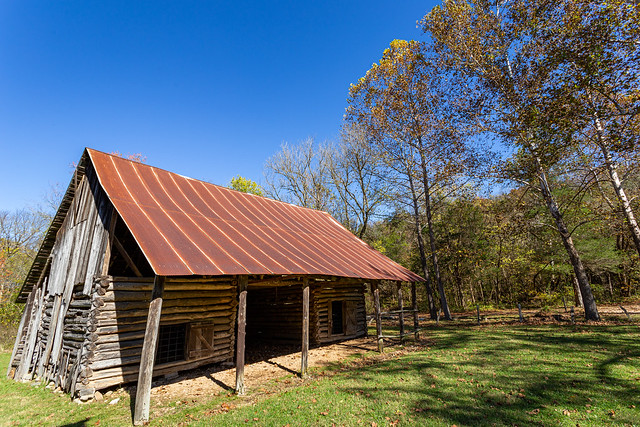
The farmstead also contains several other historic buildings, including several barns. This one was built in the 1912:

Untitled

Which sits next to a smaller barn, which was built in the 1920s:

Untitled

Untitled

And also there are these two old buildings - they were used as a machine shop and a chicken coop. They were both built in the 1950s.

Untitled

From here a road heads off through the trees, leading to a small cemetery.

Ease On Down The Road

And behind the old cabin is a small outhouse, which was built in the 1930s. The outhouse, or privy, was built as part of a Works Progress Administration program during the Great Depression. Rural farmers across the US could apply for a WPA privy, with the intention that it would help cut down on diseases like cholera or typhoid that was caused by contaminated water supplies or from flies. Between 1933 and 1945, over 2.3 million privies like this one were built across the country. The Hickman family were later reported as saying that the outhouse was the only federal assistance they received during the Depression.

When You Gotta Go

It's incredible to me that this house has managed to survive, and is still standing after all these years. It is really hard to imagine the people who lived here, building a house deep in a forest in the middle of the frontier back in the days before electricity. Could they have ever imagined that their old house would still be here after almost two centuries? Or that tourists in the future would travel there and take a picture of their outhouse?

Untitled

Monday, December 7, 2020

Parker-Hickman Homestead

There are lots of historical places within the boundaries of the Buffalo National River, and one of the largest and well-preserved is the old Parker-Hickman Homestead. The homestead is situated at the foot of a ridge, not too far from the waters of the Buffalo River. The oldest building here dates back to the late 1840s, and is believed to be the oldest building in the park. It's hard to imagine what it must have been like when the first settlers cleared the land and built the log cabin by hand. 

IMG_6937-2 

Amazingly, the home was occupied until 1978. In 1982 the National Park Service purchased the property and stabilized and preserved the home and the other buildings in the homestead. While the home is empty now, the door is unlocked and you are invited to go inside to take a look (just please don't leave graffiti or mess anything up!). Although the home hasn't been occupied in over 40 years, you can still see hints of the home's past. In one room, there are layers of newspaper stuck to the wall. In the olden times, people used newspaper as a sort of insulation.

IMG_6853-2

At the back of the house is an addition, which was completed in the early 1900s. The house has seen a lot of history, even during the Civil War. Near the end of the war after US troops liberated Little Rock and the fledgling Confederate government had to flee, most of the mountainous areas of the state was left uncontrolled by either army. In the power vacuum that followed, guerrilla fighters roamed the countryside. A skirmish among dueling guerrilla fighters occurred near the Parker-Hickman Homestead, and the home was used a field hospital.

IMG_6861-2

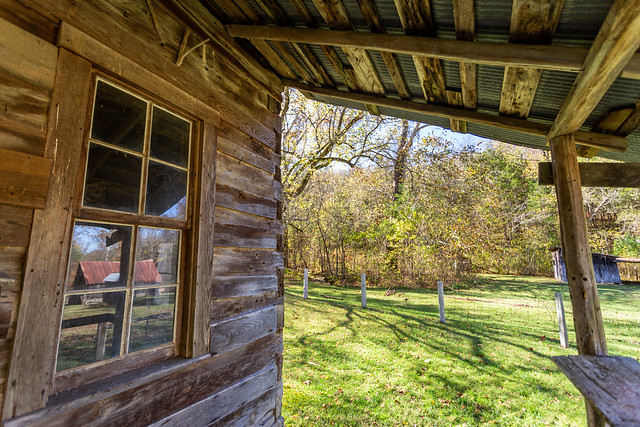
The house also has a nice front porch, from which you can see the other buildings in the farmstead. Along with the house, there are several barns, sheds, a granary, a smokehouse and even a little outhouse (which dates back to the 1920s, but I didn't investigate to see how it was). This is the view of the porch, with one of the barns reflected in the window.

IMG_6881-2

The largest barn in the homestead dates back to 1912.

IMG_6931-2

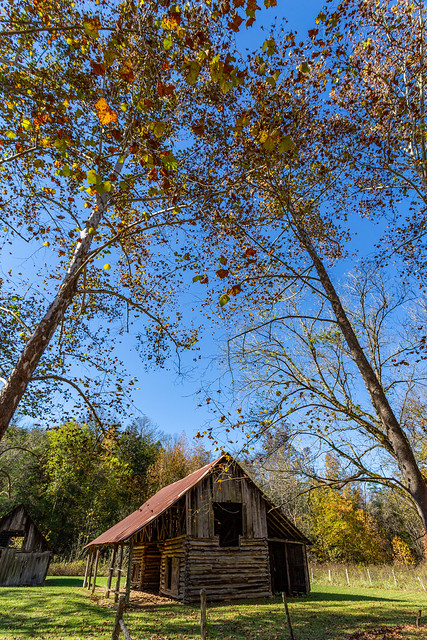
And one final shot of the barn, framed under these towering trees showing off a bit of fall color.  

IMG_6953-2